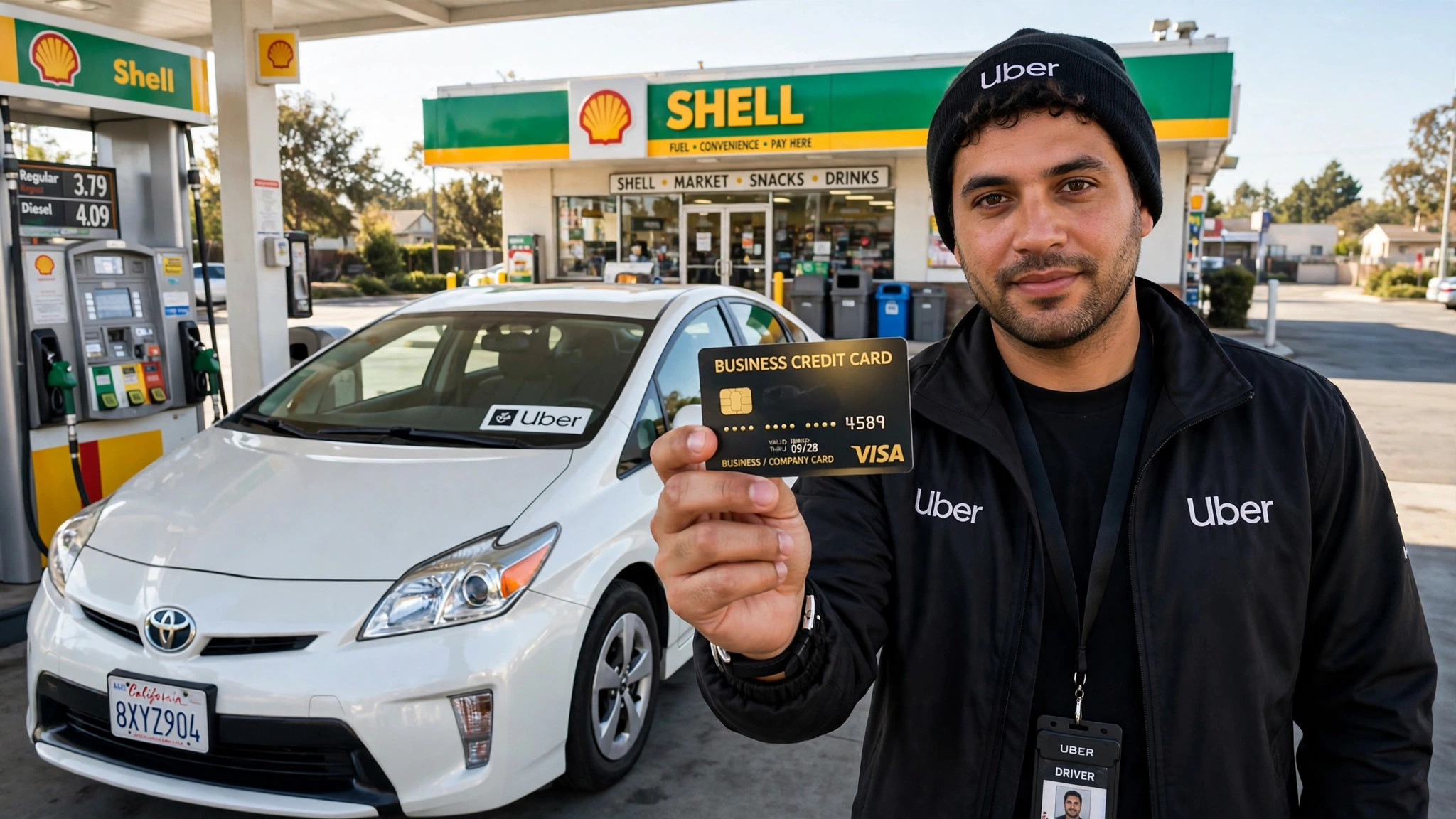
The best business credit card for an Uber driver with no LLC is the Chase Ink Business Cash, because it earns 2% back on gas and restaurants with a $0 annual fee. You can apply as a sole proprietor using your own name and Social Security number — no LLC, no EIN, and no business bank account required.
You do not need to form a company to get a business credit card. If you drive for Uber, you already are a business in the eyes of the card issuers: a sole proprietorship. Every gallon of gas, every phone bill, and every car wash is a business expense. A business card lets you earn rewards on those expenses and keep them separate from personal spending. The only question is which card fits an Uber driver's spending best.
You Already Qualify: How Sole Proprietor Applications Work
When you apply for a business credit card as a sole proprietor, the application asks for a business structure. You select "Sole Proprietor." Your legal business name is your own name. Your tax ID is your Social Security number. No LLC, no EIN, and no business bank account are needed. If you later form an LLC or get an EIN, you can update the account, but neither is required to apply.
Underwriting for sole proprietor cards is based on your personal credit and your total personal income — not just your Uber earnings. That matters, because it means your driving income is one part of the picture, and a decent personal credit score carries most of the weight. Issuers will ask for your total annual income, your monthly housing payment, and an estimate of your business revenue. Be honest and realistic: report your Uber earnings as your business revenue, and your total household income where the form asks for it.
One more thing to know: a business card application usually results in a hard inquiry on your personal credit report, and most issuers hold you personally responsible for the balance. Paying on time helps your personal credit, and missing payments hurts it.
The Best Business Cards for Uber Drivers Compared
| Card | Annual fee | Rewards | Best for |
|---|---|---|---|
| Chase Ink Business Cash | $0 | 5% on first $25,000/yr combined at office supply stores and internet, cable, and phone services; 2% on first $25,000/yr at gas stations and restaurants; 1% on other purchases | Gas and phone bills |
| Chase Ink Business Unlimited | $0 | 1.5% on everything | Simple flat-rate rewards |
| Amex Blue Business Cash | $0 | 2% on eligible purchases up to $50,000/yr, then 1% | High flat-rate rewards |
| Capital One Spark Cash Select | $0 | 1.5% on everything; 5% on hotels and rental cars via Capital One Travel | Travel bookings |
| Chase Ink Business Preferred | $95/yr | Travel rewards | Frequent travel |
Source: card issuer published terms, November 2026. Reward rates and offers change; check the current offer before applying.
For most Uber drivers, the choice comes down to two $0-fee cards: Ink Business Cash and Amex Blue Business Cash. Ink Business Cash is the gas pick. Gas is a driver's biggest recurring expense, and 2% back on gas beats the flat 1.5% cards by a clear margin. It also earns 5% on internet, cable, and phone services — and your phone plan is a genuine business cost when you drive. Amex Blue Business Cash wins if your spending is spread out and you want a simple 2% on almost everything up to $50,000 a year, with no categories to track.
Chase Ink Business Unlimited and Capital One Spark Cash Select both pay 1.5% on everything, which is fine but rarely beats Ink Business Cash for a driver whose spending is concentrated in gas, phone, and food. Ink Business Preferred costs $95 a year and is built for travel, so it only makes sense if you fly or stay in hotels often. Welcome offers change regularly, so check the current offer on the issuer's site before applying.
Worked Example: What an Uber Driver Actually Earns
Suppose Carlos drives full-time for Uber and spends $600 a month on gas, $150 on phone and internet, $300 on restaurants, and $250 on everything else — car washes, supplies, and the occasional repair. That is $1,300 a month, or $15,600 a year.
With Ink Business Cash: gas earns 2% on $7,200 a year, which is $144. Phone and internet earn 5% on $1,800, which is $90. Restaurants earn 2% on $3,600, which is $72. Everything else earns 1% on $3,000, which is $30. Total: $336 a year.
With Amex Blue Business Cash: 2% on the full $15,600, which is $312 a year. With Ink Business Unlimited or Spark Cash Select: 1.5% on $15,600, which is $234 a year.
Ink Business Cash wins this example by $24 over Amex and by $102 over the flat 1.5% cards — and the gap grows if you spend more on gas. Your spending mix decides the winner, not the headline rate. Run your own numbers first with the gig true pay calculator, or browse the full tools hub.
How to Apply as a Sole Proprietor
1. Pick the card that matches your spending. If gas and phone dominate, Ink Business Cash. If your spending is spread out, Amex Blue Business Cash. 2. Fill in the business section. Business structure: Sole Proprietor. Legal business name: your own name. Tax ID: your Social Security number. 3. Report your income honestly. Business revenue is your Uber earnings; total income is your full household income. 4. Keep driving expenses on the card. Gas, phone, car washes, and supplies go on the business card. Personal spending stays on a personal card, which makes tax time far easier. 5. Pay in full every month. Rewards are worth roughly 1.5% to 2%, while card interest rates run far higher. Carrying a balance wipes out a year of rewards in a month or two.
If your application is denied, do not apply for three more cards the same week. Each application adds a hard inquiry. Instead, call the issuer's reconsideration line and ask what drove the decision — sometimes a lower credit limit or a corrected income figure is enough to turn a no into a yes.
Pairing a Business Card With a Personal Gas Card
A business card does not have to do everything. Many drivers pair Ink Business Cash with a personal gas credit card to squeeze more from fuel spending. The business card handles gas at 2% plus phone at 5%, while a dedicated personal gas card can earn a higher rate at the pump. Compare the options in our guide to the best gas credit card for delivery drivers. The key rule is the same either way: never pay interest to chase rewards, and never put personal spending on the business card just to hit a bonus.
Keeping business and personal spending separate also pays off at tax time. Gig workers are self-employed for tax purposes, and clean records make it far easier to claim deductions like mileage and phone costs. A business card statement is not a substitute for proper records, but it is a much better starting point than a single mixed account. For a full picture of what driving really pays after all costs, see our breakdown of how much a DoorDash driver really makes after gas and taxes — the same cost logic applies to Uber.
What to Avoid
Applying as an LLC you do not have. Do not invent a business name or an EIN. Apply as a sole proprietor with your own name and SSN; that is the correct and honest route.
Chasing a welcome offer with spending you cannot afford. A bonus is only worth it if the spending is money you would have spent anyway. Buying things to hit a threshold is how drivers end up carrying a balance.
Mixing personal and business spending. It muddies your tax records and can complicate deductions. One card for driving, one card for personal life.
Ignoring the annual fee math. Ink Business Preferred's $95 fee only pays off if your travel rewards clear $95 a year. For most drivers, the $0-fee cards earn more.
FAQ
Can I get a business credit card as an Uber driver with no LLC? Yes. Apply as a sole proprietor using your own name as the business name and your Social Security number as the tax ID. No LLC, EIN, or business bank account is required.
Will a business credit card affect my personal credit score? Usually yes. Most issuers run a hard inquiry on your personal credit when you apply, and you are personally responsible for the balance.
What income do I report if Uber is my only job? Report your Uber earnings as business revenue and your total personal income where the form asks for it. Underwriting uses personal credit plus total personal income, so include all income sources honestly.
Is Ink Business Cash or Amex Blue Business Cash better for gas? Ink Business Cash, because it pays 2% on gas and 5% on phone and internet services. Amex Blue Business Cash pays a flat 2% on everything, which wins only if your spending is spread across many categories.
Do I need a business bank account first? No. A business bank account is not required to apply for a business credit card as a sole proprietor. Your payouts can continue going to your personal checking account.
Can I use the card for personal purchases? You can, but you should not. Mixing personal spending into a business account complicates your tax records and your deduction claims. Keep a separate personal card for personal spending.
The Bottom Line
An Uber driver with no LLC can get a business credit card today by applying as a sole proprietor with their own name and Social Security number. For most drivers, Chase Ink Business Cash is the best pick: $0 annual fee, 2% back on gas and restaurants, and 5% on phone and internet. If your spending is spread out rather than gas-heavy, Amex Blue Business Cash at a flat 2% is the better fit. Either way, pay in full every month — rewards only work when interest never gets a chance to cancel them out.
This article is general information only and is not financial advice. Card terms, reward rates, and offers change over time and vary by applicant. Check current terms directly with the card issuer before applying.
Last verified: November 2026