The best gas credit card for delivery drivers is the Citi Custom Cash, because it pays 5% on your top spending category — gas, for most drivers — on up to $500 of spending per month, with a $0 annual fee. Warehouse-club shoppers should also consider the Sam's Club Mastercard and Costco Anywhere Visa, which also pay 5% on gas.
This guide covers DoorDash, Uber Eats, Grubhub, Instacart, Amazon Flex, and any driver who buys fuel for work. The math is the same whatever app you use: you drive a lot, you buy a lot of gas, and the card you use at the pump decides how much comes back.
Gas is usually a delivery driver's largest cash expense. Fuel, wear, and tax together leave most drivers with 60 to 70 percent of gross pay, and fuel is the part you pay every week. A 5% card does not make the job cheap, but on $350 to $400 a month of fuel it returns $200 or more a year — without changing a single delivery.
How much gas do delivery drivers buy?
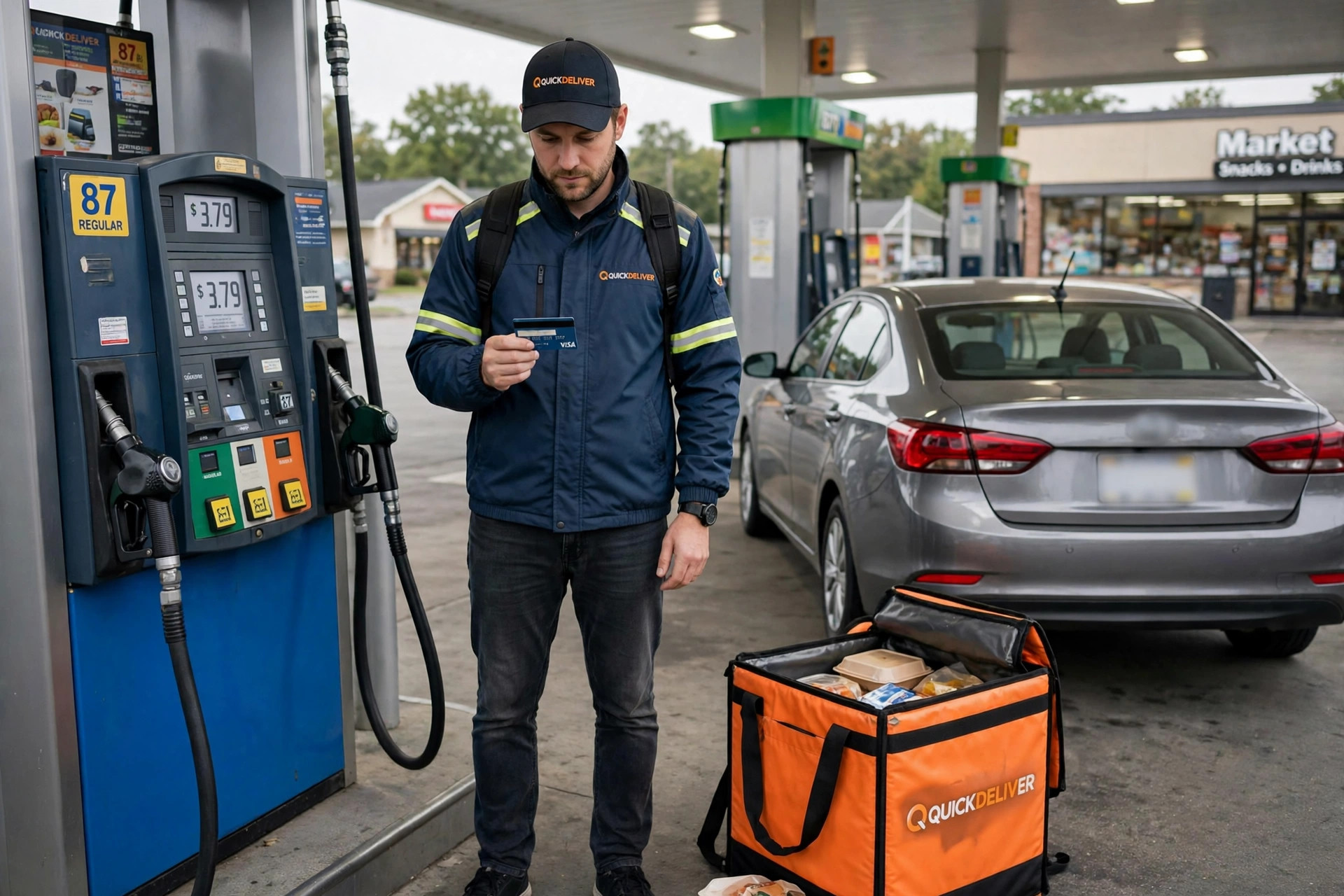
A full-time driver can easily cover 600 miles a week. At about 25 miles per gallon, that is roughly 24 gallons a week. At an illustrative $3.50 per gallon, that is about $84 a week, or about $364 a month. At 30 miles per gallon, it is about $70 a week and about $303 a month.
Those are illustrative figures; your real number depends on your car, city, and hours. True vehicle costs are typically $0.45 to $0.65 a mile, including gas at $0.12 to $0.18, depreciation at $0.15 to $0.25, maintenance at $0.08 to $0.12, insurance at $0.03 to $0.05, and self-employment tax at $0.07 to $0.10. Gas is only one part, but it is the part a card can directly reduce. For the full picture, see our how much a DoorDash driver really makes after gas and taxes guide, and the Uber driver cost per mile calculator guide.
The best gas cards at a glance
| Card | Gas rate | Annual cap or limit | Annual fee | Best for |
|---|---|---|---|---|
| Citi Custom Cash | 5% on top category | Up to $500/month | $0 | Most drivers |
| Sam's Club Mastercard | 5% on gas | Up to $6,000/year | $0 with membership | Sam's Club members |
| Costco Anywhere Visa | 5% Costco gas; 4% other gas | Check current terms | $0 with membership | Drivers near a Costco |
| Amex Blue Cash Preferred | 3% at US gas stations | 6% supermarkets up to $6,000/year | $95 | Drivers who buy groceries |
| Wells Fargo Autograph | 3% on gas | No cap stated | $0 | Simple 3% gas |
| Chase Freedom Flex | 5% rotating categories | Gas often 2–3 quarters a year | $0 | Drivers who track categories |
| Citi Double Cash | 2% on everything | No cap | $0 | Backup card |
| DoorDash Rewards Mastercard | 1% on gas | No cap | $0 | DoorDash orders, not gas |
Sources: card issuer pages as published in 2026; reward rates and caps are subject to change, so check the current offer before you apply. Welcome-bonus amounts are not stated here because they change frequently — check the current offer on the issuer's site.
Yearly savings compared
The table below uses an illustrative $350 a month in gas, or $4,200 a year, and assumes the card's gas rate applies to all of it. Real savings will be lower if a cap applies.
| Gas rate | Yearly cash back on $4,200 of gas | Example card |
|---|---|---|
| 5% | $210 | Citi Custom Cash, Sam's Club, Costco at Costco |
| 4% | $168 | Costco Anywhere Visa at other stations |
| 3% | $126 | Amex Blue Cash Preferred, Wells Fargo Autograph |
| 2% | $84 | Citi Double Cash |
| 1% | $42 | DoorDash Rewards Mastercard, most basic cards |
The gap between 5% and 1% is $168 a year on this spending, and $210 a year for a driver spending $500 a month on fuel. Caps matter at high mileage: the Citi Custom Cash pays 5% on up to $500 a month, then 1%, and Sam's Club pays 5% up to $6,000 a year. Very high-mileage drivers should plan a second card for fuel above the cap — the Wells Fargo Autograph at 3% is a good overflow card.
The 5% cards in detail
The Citi Custom Cash is the most flexible 5% gas card: no membership, no particular station. It pays 5% on your top category each billing cycle, up to $500 a month, then 1%. For most drivers, gas is that top category. The risk is a month when another category overtakes gas, and gas drops to 1%.
The Sam's Club Mastercard pays 5% on gas up to $6,000 a year, and 3% on dining. The Costco Anywhere Visa pays 5% on Costco gas and 4% on other gas, with 3% on restaurants and travel. Do not join a warehouse club only for the card — the fee eats into the reward, and the 5% rate only helps if you can fill up there.
3% cards, rotating cards, and the DoorDash card
The Amex Blue Cash Preferred pays 3% at US gas stations and 6% at US supermarkets, up to $6,000 a year. At $500 a month in groceries, 6% is $360 a year. The catch is the $95 annual fee — you need to earn at least $95 more than a no-fee card would pay to come out ahead.
The Wells Fargo Autograph pays 3% on gas, dining, travel, transit, and streaming, with a $0 annual fee. It is the simplest good gas card: no tracking, no membership, and the same 3% on dining. On $350 a month of gas, it returns about $126 a year.
The Chase Freedom Flex pays 5% on rotating categories, and gas is often a rotating category for two or three quarters a year. In a gas quarter it matches the best cards; in other quarters, gas earns 1%.
The DoorDash Rewards Mastercard pays 4% on DoorDash and Caviar, 3% on dining, and 2% on groceries, with a $0 annual fee and a free year of DashPass — but only 1% on gas. Use it for food, not at the pump. Our best credit card for DoorDash drivers gas cash back guide explains the two-card DoorDash setup in detail.
Fleet cards and gas-station cards: what to know
Gas-station branded cards sometimes offer a per-gallon discount at that brand's stations, but usually pay little elsewhere. No specific rate was verified for this guide — check the current offer for the brand you actually use, and compare it with the 5% cards above.
Fleet cards are designed for businesses with several vehicles, offering fuel discounts and reporting. For a single driver, a fleet card is usually the wrong tool: discounts are aimed at volume. Terms vary widely and none was verified for this guide. For most solo drivers, a 5% personal gas card is simpler and pays more.
Worked example: a delivery driver's year at the pump
Take an illustrative driver who spends $380 a month on gas, $240 a month on dining, and $120 a month on DoorDash orders. With the Citi Custom Cash, gas earns 5%, or $19.00 a month. With Wells Fargo Autograph, gas earns 3%, or $11.40. With Citi Double Cash, gas earns 2%, or $7.60.
The best combination splits spending: Citi Custom Cash for gas ($19.00) plus DoorDash Rewards Mastercard for dining at 3% ($7.20) and DoorDash orders at 4% ($4.80). The combined return is $31.00 a month, or about $372 a year, with no annual fee on either card. Over a year, the 5% gas card alone returns $228 on $380 a month of fuel, against $137 for a 3% card and $91 for a 2% card.
To see how fuel fits into your own take-home pay, run your numbers through the gig true pay calculator. You can also browse the full set of finance tools on Orafyn.
How to choose
If you spend $250 or more a month on fuel, a 5% gas card should be your first card: Citi Custom Cash for flexibility, Sam's Club if already a member, or Costco if your route passes one. Next, look at your second-biggest category: DoorDash and dining point to the DoorDash card, groceries to Amex, and simplicity to Wells Fargo Autograph at 3%.
Do not carry a balance to chase cash back — interest will erase the reward many times over, so pay in full each month. And do not apply for several cards at once; each application can affect your credit.
FAQ
What is the best gas credit card for delivery drivers? For most drivers, the Citi Custom Cash: 5% on your top category — usually gas — on up to $500 a month, with a $0 annual fee. Sam's Club and Costco cards also pay 5% on gas if you already hold the membership.
How much can a delivery driver save with a 5% gas card? On an illustrative $350 a month of gas, 5% returns $210 a year, against $126 at 3% and $84 at 2%. Your saving scales with your actual fuel spending.
Do gas-station cards beat general gas cards? Sometimes, at that one brand's stations, but they usually pay little elsewhere. Compare the brand's current offer with a 5% general gas card, and only choose the station card if you almost always fill up at that brand.
Can I use a 5% gas card and a DoorDash card together? Yes. Many drivers carry two no-fee cards: one for gas and one for DoorDash, dining, and groceries. Splitting spending by category earns more than using one card for everything.
Will cash back affect my delivery taxes? Cash back is generally treated as a rebate, not as income, but rules can change. Fuel itself is covered by the mileage deduction for tax purposes — do not double-count it.
Disclaimer: This article is general information only and is not financial advice. Card rewards, fees, caps, and offers change frequently. Fleet and gas-station card terms vary by issuer and were not verified for this guide — check the current terms before you apply. Consult a qualified financial adviser or tax professional for advice about your circumstances.
Last verified: November 2026