DoorDash drivers can deduct business mileage, phone costs, supplies, tolls, parking, and a qualifying home office, and the mileage deduction alone is usually worth thousands of dollars a year. The key is tracking every business mile and keeping receipts, because DoorDash does not withhold tax and every undocumented expense is money you pay tax on unnecessarily.
DoorDash drivers are independent contractors. That means no tax is withheld from your pay, and you are responsible for reporting income and paying both income tax and self-employment tax. It also means you can deduct the ordinary and necessary costs of running your delivery business. Many drivers pay far more tax than they need to, simply because they never kept a mileage log.
This guide covers every major write-off, explains the mileage rules in detail, and works through the tax saving on real numbers. All estimates are labelled as illustrative.
How DoorDash driver taxes work
Your DoorDash income is business income, reported on Schedule C. Gross pay is what DoorDash paid you, including base pay, tips, and promotions. Net profit is gross pay minus deductible business expenses. Income tax is charged on net profit, and self-employment tax is charged on top of that.
Self-employment tax is 15.3% on 92.35% of net profit, calculated on Schedule SE. It covers Social Security and Medicare. Each $1,000 of business expense saves about $140 in self-employment tax before income tax; with income tax added, the total saving is usually $250 to $350, depending on your bracket. Those are illustrative figures, but they show why deductions matter: a $10,000 mileage deduction can easily save $2,500 or more in total tax.
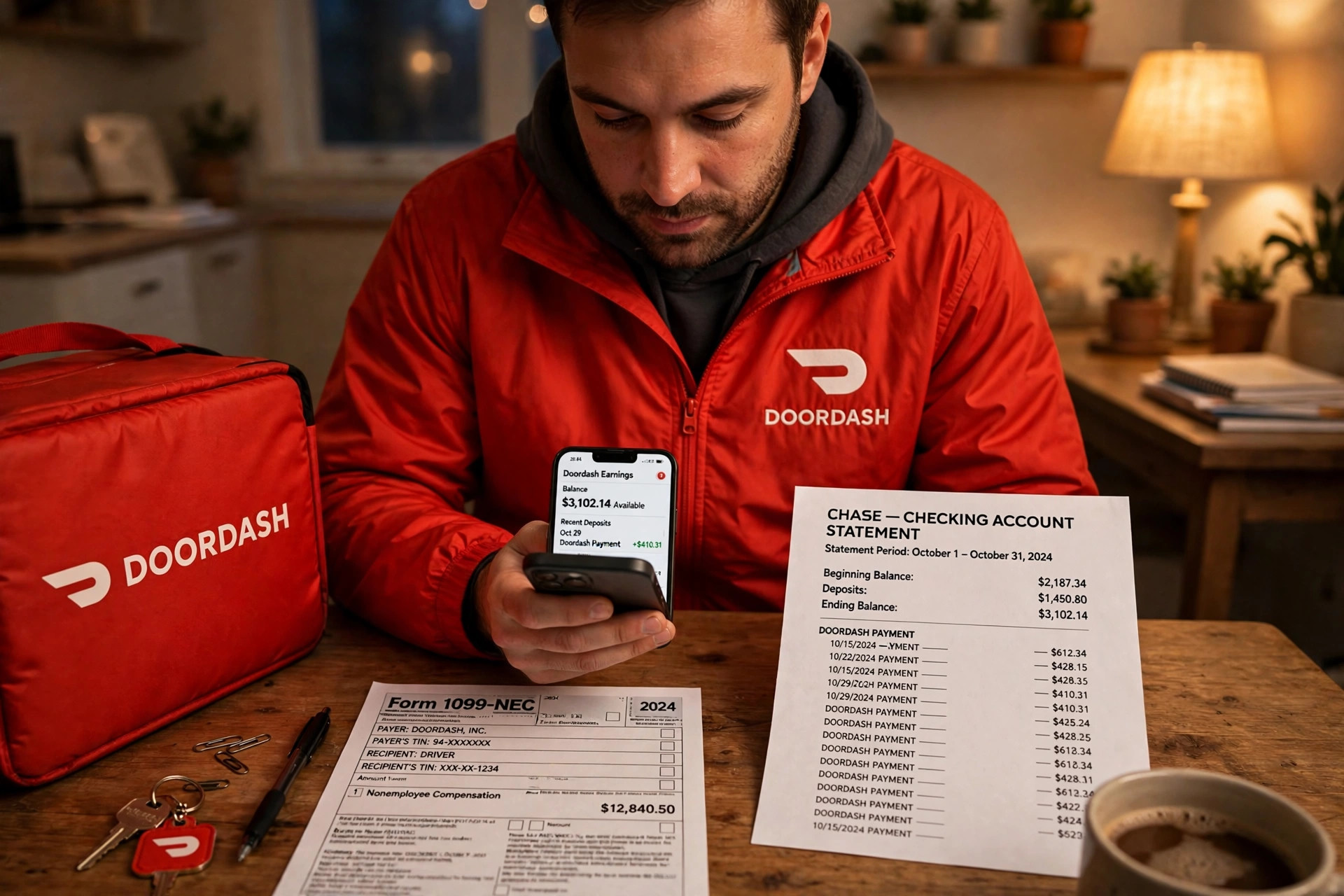
DoorDash issues a 1099-NEC if earnings meet the IRS reporting threshold. All income is taxable whether or not a form arrives, so keep your own records of every payout.
There is also the qualified business income (QBI) deduction, worth up to 20% of qualified business income. For 2026, the thresholds are about $201,750 for single filers and about $403,000 for married couples filing jointly. Most drivers fall well below those thresholds. It is claimed on your personal return, after net profit, so it does not reduce self-employment tax — only income tax.
Mileage: the biggest deduction
| Item | 2026 rate or rule |
|---|---|
| Standard mileage, Jan 1–Jun 30, 2026 | $0.725 per mile |
| Standard mileage, Jul 1–Dec 31, 2026 | $0.76 per mile |
| What the mileage rate replaces | Gas, insurance, repairs, depreciation |
| Deductible on top of mileage | Parking fees and tolls |
| 600 miles a week, first-half rate | $435 a week in mileage value |
| 15,000 business miles, first-half rate | About $10,875 in deductions |
| 5,000 miles Jan–Jun + 5,000 miles Jul–Dec | $7,425 in deductions |
Sources: IRS standard mileage rates for 2026, as supplied for this guide; rates change by year and, in 2026, by half-year. Never write $0.725 as the rate for all of 2026 — the rate rises to $0.76 on July 1. Keep a log that records the date and the miles for each half of the year separately, so you can apply the right rate to each period.
Deductible miles include driving from accepting an order to the restaurant, from the restaurant to the customer, and waiting between orders while available on the app. Personal errands and miles with the app off are not deductible. A qualifying home office can make home-to-first-delivery miles deductible, but the office must be used regularly and exclusively for business.
You must choose between standard mileage and actual expenses for each car, per year. To use standard mileage later, you must choose it in the first year you use the car for business. If you start with actual expenses, you cannot switch later for that car. Most drivers are better off with standard mileage, because it is simpler and usually larger.
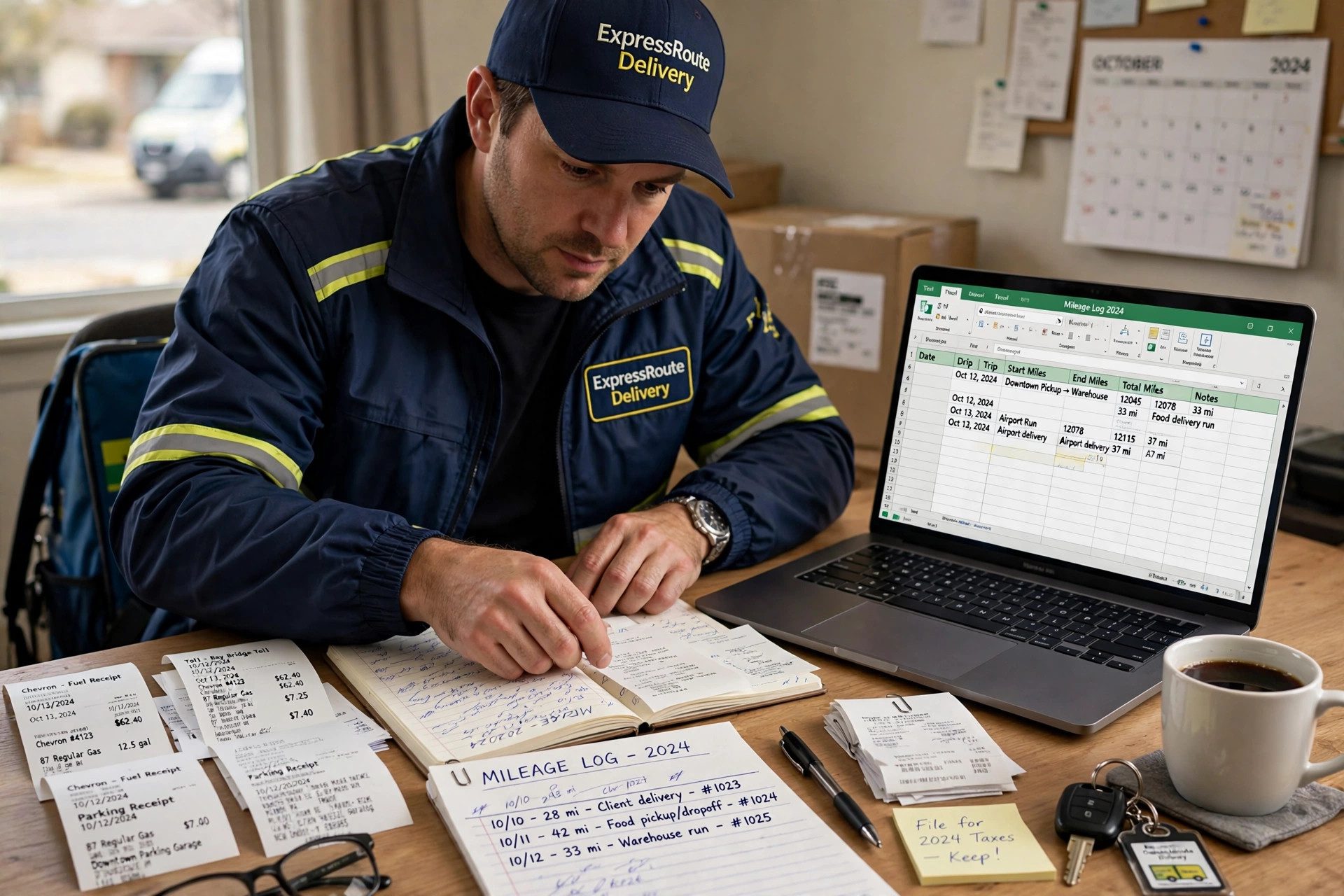
A mileage log does not need to be fancy. A notebook, spreadsheet, or mileage app all work, as long as it records the date, places, purpose, and miles. A log written from memory at tax time is far weaker than one kept as you go.
Other deductions drivers often miss
Mileage is the headline, but several smaller deductions add up. The rule for all of them is the same: the expense must be ordinary and necessary for your delivery work, and you must be able to prove it.
Your phone is first. If you use your phone for DoorDash, the business share of your bill is deductible: 80% business use means deduct 80% of the bill. A phone bought mainly for delivery may also be deductible, in whole or in part. Keep the bills and note the business percentage.
Supplies are next. Hot bags, delivery bags, a phone mount, a car charger, and insulated carriers are deductible if used for deliveries, as are notebooks and pens used for records. Keep receipts even for small items — a $30 hot bag is a $30 deduction, and small deductions add up.
Tolls and parking are deductible on top of mileage. Keep the receipt or toll statement for each one; a driver in a toll-heavy city can spend hundreds of dollars a year on them.
A home office is deductible if you use part of your home regularly and exclusively for business — for example, a desk for bookkeeping and mileage tracking. The simplified deduction is $5 per square foot, up to 300 square feet, or $1,500 a year. Do not claim a room that is also a bedroom or living room; the exclusive-use test is strict.
Other possible deductions include the business share of car washes, roadside assistance, and bookkeeping or tax-preparation fees. Health insurance premiums may also be deductible, subject to detailed rules. If unsure whether an expense qualifies, keep the receipt and ask a tax professional.
Worked example: the tax saving from mileage
Take an illustrative driver who earns $30,000 in gross DoorDash pay in a year and drives 15,000 business miles, all in the first half of the year at $0.725 a mile. The mileage deduction is 15,000 × $0.725, or $10,875. Add $500 in phone costs, $200 in supplies, and $300 in tolls and parking, for total deductions of $11,875. Net profit is $30,000 minus $11,875, or $18,125.
Self-employment tax is 15.3% on 92.35% of $18,125, which is about $2,561. Without any deductions, self-employment tax on $30,000 would be about $4,239. The deductions alone save about $1,678 in self-employment tax, before any income-tax saving. Add income tax — at an illustrative 12% marginal rate, the $11,875 in deductions saves a further $1,425 — and the total tax saving is roughly $3,100. These are illustrative figures, and your own saving depends on your income, bracket, and other deductions, but the scale is real.
Now try the split-year example. A driver with 5,000 miles from January to June and 5,000 miles from July to December claims 5,000 × $0.725 plus 5,000 × $0.76, or $3,625 plus $3,800, for $7,425. Using $0.725 for all 10,000 miles would give $7,250 — $175 less. That is a small difference, but it is money left on the table, and it is also wrong on the return. Keep the halves separate.
To see how these deductions affect your own take-home pay, use the gig true pay calculator. You can also browse the full set of finance tools on Orafyn. For the wider picture of what a driver keeps after fuel and tax, read how much a DoorDash driver really makes after gas and taxes, and for fuel costs, see our best credit card for DoorDash drivers gas cash back guide. Uber drivers face the same mileage rules; see the Uber driver cost per mile calculator guide for the rideshare version.
Quarterly payments and record-keeping
Because no tax is withheld, most drivers should pay estimated tax quarterly. The IRS expects payments in April, June, September, and January, and underpaying can lead to penalties. A common starting point is to set aside 20 to 30 percent of net profit from every payout, in a separate account, and use it for the quarterly payments. Your own percentage depends on your total income and tax bracket.
Record-keeping makes all of this work. Keep a mileage log, receipts for phone, supplies, tolls, and parking, and copies of every payout statement. Photograph paper receipts, because they fade, and keep records for at least three years after you file.
Three mistakes cost drivers the most. The first is not tracking miles at all — without a log you cannot claim the largest deduction. The second is double-counting: if you use standard mileage, do not also deduct gas, insurance, repairs, and depreciation. The third is mixing personal and business spending with no records. A separate card for delivery expenses makes record-keeping far easier.
FAQ
What is the standard mileage rate for DoorDash drivers? For 2026, $0.725 a mile from January 1 to June 30, and $0.76 a mile from July 1 to December 31. Keep a log split by half-year so you apply the right rate to each period.
Can DoorDash drivers deduct gas? Not separately if you use the standard mileage rate — the rate already covers gas, insurance, repairs, and depreciation. If you use the actual-expenses method instead, you can deduct gas directly, but you cannot use both methods for the same miles.
Are miles driven while waiting for an order deductible? Yes, if you are available on the app and waiting for an order. Miles driven with the app off, and personal errands, are not deductible.
Do I need a mileage log, or can I estimate? You need a log. The IRS expects a record of the date, places, purpose, and miles for each trip. Estimates made at tax time are far weaker than a log kept as you go.
What if DoorDash did not send me a 1099? All income is taxable whether or not a form arrives. DoorDash issues a 1099-NEC if earnings meet the IRS reporting threshold, but you must report your own records regardless.
Can I deduct my phone and home office? Yes, if they meet the rules. Deduct the business share of your phone bill, and a home office only if the space is used regularly and exclusively for business. The simplified home-office deduction is $5 per square foot, up to $1,500 a year.
Disclaimer: This article is general information only and is not tax advice. Tax rates, thresholds, and IRS rules change, and individual situations differ. Keep your own records and consult a qualified tax professional before making tax decisions or filing a return.
Last verified: November 2026