For an Uber driver in California, full coverage averages about $263 per month and liability-only about $125 per month, according to Insurify, November 2026. A rideshare endorsement typically adds $15 to $30 per month and closes the gap when the app is on but you have no passenger yet.
What rideshare insurance means in California
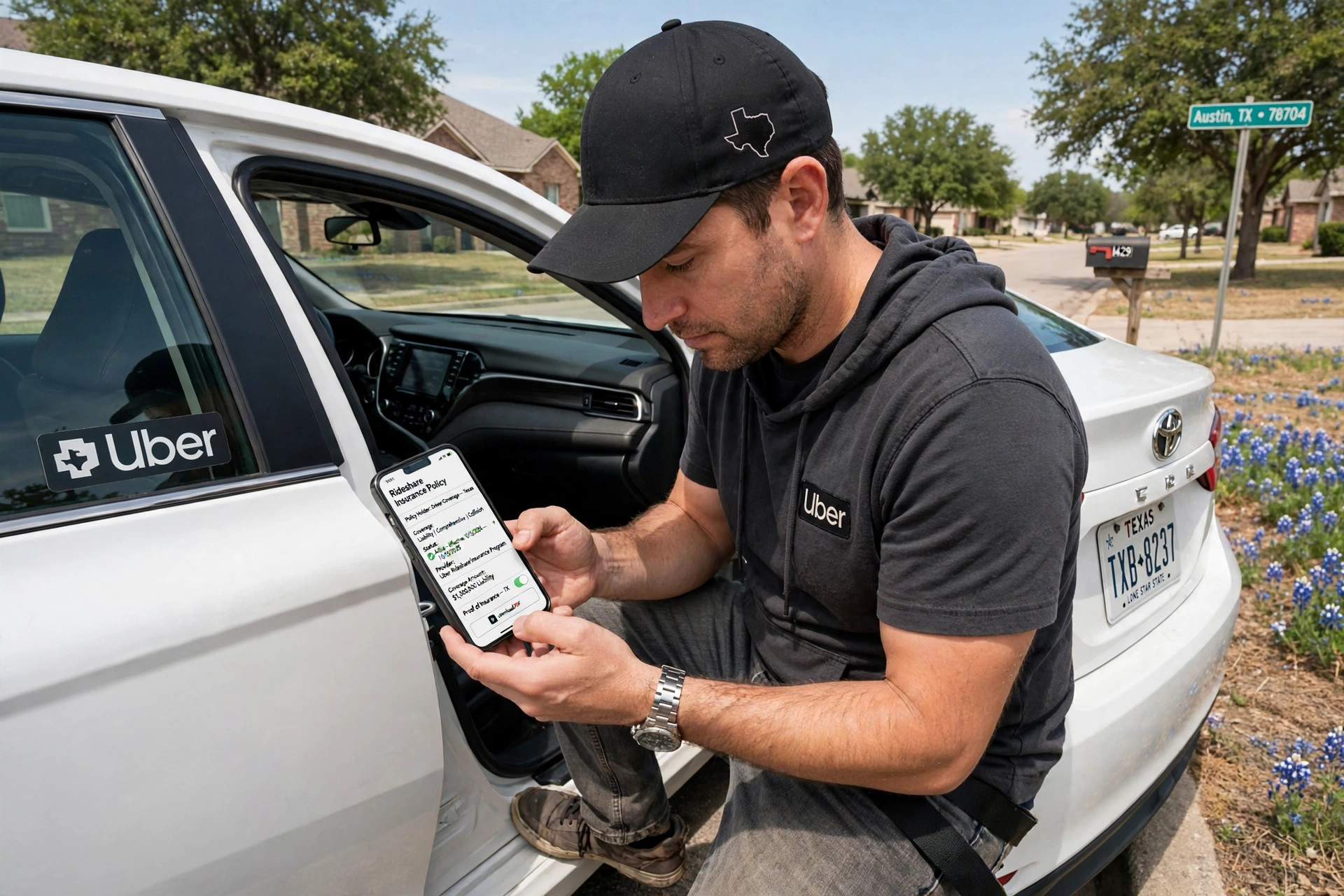
Rideshare insurance is not one policy. It is the combination of your personal car insurance, a rideshare endorsement or add-on, and the insurance that Uber or Lyft provides while you are working. Each part covers a different period, and the gap between them is where drivers get into trouble.
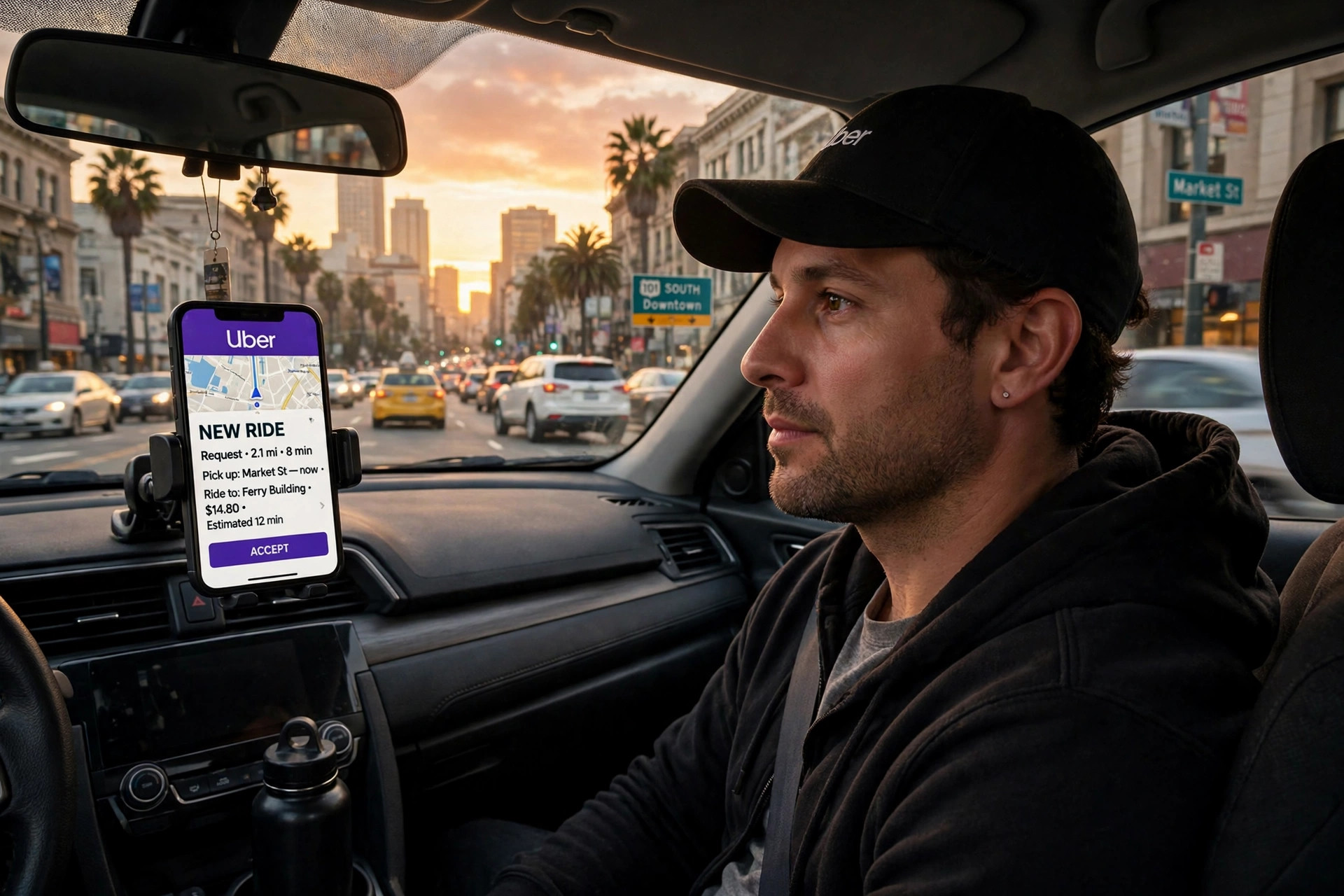
California treats transportation network companies, or TNCs, such as Uber and Lyft under specific state rules. When you are driving for personal reasons, your personal policy applies. When you turn the app on and are waiting for a ride, you are in Period 1. When you have accepted a ride and are driving to pick up the passenger, you are in Period 2. When the passenger is in the car, you are in Period 3. The TNC must provide higher limits while the app is on, but those limits do not cover everything, and they do not replace your personal policy.
More than 800,000 rideshare drivers work in California. Many drive part-time, and many assume their personal policy covers them while they wait for a ride. In most cases it does not. A standard personal policy usually excludes driving for hire. That is why an endorsement matters even if you only drive a few hours a week.
California minimums and TNC periods
California's minimum liability for a personal driver is 30/60/15: $30,000 for bodily injury per person, $60,000 for bodily injury per accident, and $15,000 for property damage per accident. Those are minimums, not recommendations. Most drivers need higher limits, especially in a state with high repair and medical costs.
The TNC periods have their own minimums. In Period 1, when the app is on and you are waiting for a request, the TNC minimum is $50,000 per person and $100,000 per accident for bodily injury, plus $25,000 for property damage. That is higher than the personal minimum, but it is still limited, and it does not include collision coverage for your own car.
In Period 2 and Period 3, the TNC must provide $1,000,000 in liability coverage. Period 3 also includes uninsured and underinsured motorist coverage of $60,000 per person and $300,000 per accident. That limit changed on January 1, 2026, when California Senate Bill 371 cut the uninsured and underinsured motorist limit from $1,000,000 to $60,000 per person and $300,000 per accident. The $1,000,000 liability limit in Period 3 did not change. The practical point is simple: Period 1 is the weakest link. The TNC coverage is lower, your personal policy may exclude rideshare, and you have no passenger yet. A rideshare endorsement is designed to fill that gap.
How much does rideshare insurance cost in California?
Use the figures below as a starting range, not as a quote. Your price will depend on your age, driving record, car, city, mileage and coverage choices.
| Coverage or add-on | Typical California cost | Source and date |
|---|---|---|
| Full coverage, personal policy average | About $263 per month | Insurify, November 2026 |
| Liability-only, personal policy average | About $125 per month | Insurify, November 2026 |
| Rideshare endorsement, typical range | $15 to $30 per month | Industry range, November 2026 |
| Mercury rideshare endorsement | About $0.90 per day, about $27 per month | Mercury, 9 states including California, November 2026 |
| USAA rideshare endorsement | About $6 per month | USAA, military only, November 2026 |
| State Farm rideshare endorsement | About $28 per month | State Farm, November 2026 |
| Allstate rideshare add-on | About $38 per month | Allstate, November 2026; covers the deductible gap vs Uber's $2,500 |
Source: Insurify averages and insurer endorsement figures as compiled for this article, November 2026. Prices are illustrative and vary by driver.
Mercury's figure of about $0.90 per day is an average across nine states including California, so a California driver may pay a little more or less. USAA's $6 per month is unusually low, but it is available only to military members and their families. Allstate's $38 per month is higher than the typical $15 to $30 range, but it is notable because it can help cover the deductible gap. Uber's collision deductible in Period 2 and Period 3 is $2,500, which is far higher than the $500 or $1,000 deductible most personal policies use. If you have an accident while carrying a passenger, you could owe $2,500 before Uber's collision coverage pays. An add-on that lowers that exposure can be worth the extra monthly cost. The endorsement itself does not replace full coverage. It extends your personal policy so that it still applies during Period 1 and, in some cases, helps with the deductible in later periods.
A worked example: a full-time Uber driver in Los Angeles
Daniel drives full-time for Uber in Los Angeles. He is 34, has a clean driving record, and drives a 2021 Toyota Camry. He buys full coverage at the California average of $263 per month, plus a rideshare endorsement at $25 per month, in the middle of the typical $15 to $30 range. His total is $288 per month, or $3,456 per year.
He drives about 1,800 miles a month for Uber, including miles driven to pick up passengers and miles driven while waiting. His insurance cost per Uber mile is therefore $288 divided by 1,800, or $0.16 per mile. That is before gas, maintenance, depreciation, phone and Uber's own fees.
If Daniel instead chose liability-only coverage at $125 per month plus the same $25 endorsement, his total would be $150 per month, or $1,800 per year, or about $0.08 per mile. That looks cheaper, but liability-only means he has no collision or comprehensive coverage for his own car. If his Camry is damaged in an accident that is his fault, or stolen, or hit by an uninsured driver outside the TNC's coverage, he pays for the repair himself. For a driver whose car is also his income, that risk is often not worth the saving.
Now consider the deductible gap. Daniel has a $1,000 collision deductible on his personal policy. If he has an accident in Period 3 and Uber's coverage applies, his deductible under Uber's policy is $2,500. The difference is $1,500 out of pocket before coverage helps. An Allstate-style add-on at about $38 per month costs $456 a year. It would pay for itself if it prevented even one $1,500 deductible gap in three years, but only if the add-on actually covers that gap in Daniel's policy. He should ask the insurer in writing what the add-on covers in Period 1, Period 2 and Period 3 before he buys it. Use a gig true pay calculator to put insurance alongside gas, maintenance and taxes, so you can see your true hourly pay after all costs. Compare rideshare insurance in Texas, delivery insurance in Florida, and the Uber driver cost-per-mile calculator via the tools hub. An endorsement matters even part-time: Period 1 is the weakest link, so compare at least three insurers and ask in writing what the add-on covers in each period.
FAQ
How much is rideshare insurance in California for an Uber driver?
Full coverage averages about $263 per month and liability-only averages about $125 per month in California, according to Insurify in November 2026. A rideshare endorsement typically adds $15 to $30 per month.
Does Uber insurance cover me when the app is on but I have no passenger?
Uber provides limited coverage in Period 1, with minimums of $50,000 per person and $100,000 per accident for bodily injury, plus $25,000 for property damage. It does not include collision coverage for your car, and your personal policy may exclude rideshare. An endorsement helps close that gap.
What is the Uber deductible in California?
Uber's collision deductible in Period 2 and Period 3 is $2,500. That is higher than most personal deductibles of $500 or $1,000, so an add-on that covers the deductible gap can be valuable.
Is a rideshare endorsement required in California?
California does not require you to buy an endorsement by name, but your personal policy usually excludes driving for hire. Without an endorsement or a commercial policy, you may have no coverage in Period 1. Most drivers need an endorsement to be properly covered.
Can I get rideshare insurance if I drive part-time?
Yes. Insurers that offer endorsements in California generally offer them to part-time drivers as well. The cost is usually the same monthly add-on, so part-time drivers should still compare the total policy cost.
Which insurer has the cheapest rideshare endorsement in California?
USAA is listed at about $6 per month but is limited to military members. Mercury is listed at about $0.90 per day, State Farm at about $28 per month, and Allstate at about $38 per month. The cheapest total policy for you will depend on your base premium, not the endorsement alone.
Disclaimer
This article is general information only and is not financial or insurance advice. Insurance rates, TNC coverage and California rules change, and your price will depend on your record, car, city and coverage choices. Get a quote from a licensed insurer or agent before you buy, and read your policy to confirm what is covered in each TNC period.
Last verified: November 2026