Yes, a gig worker can often borrow $5,000 using bank statements instead of a tax return. Many lenders accept two to three months of statements from your primary checking account, and a worker depositing $2,000 to $4,000 a month with a consistently positive balance is a strong candidate for up to $5,000.
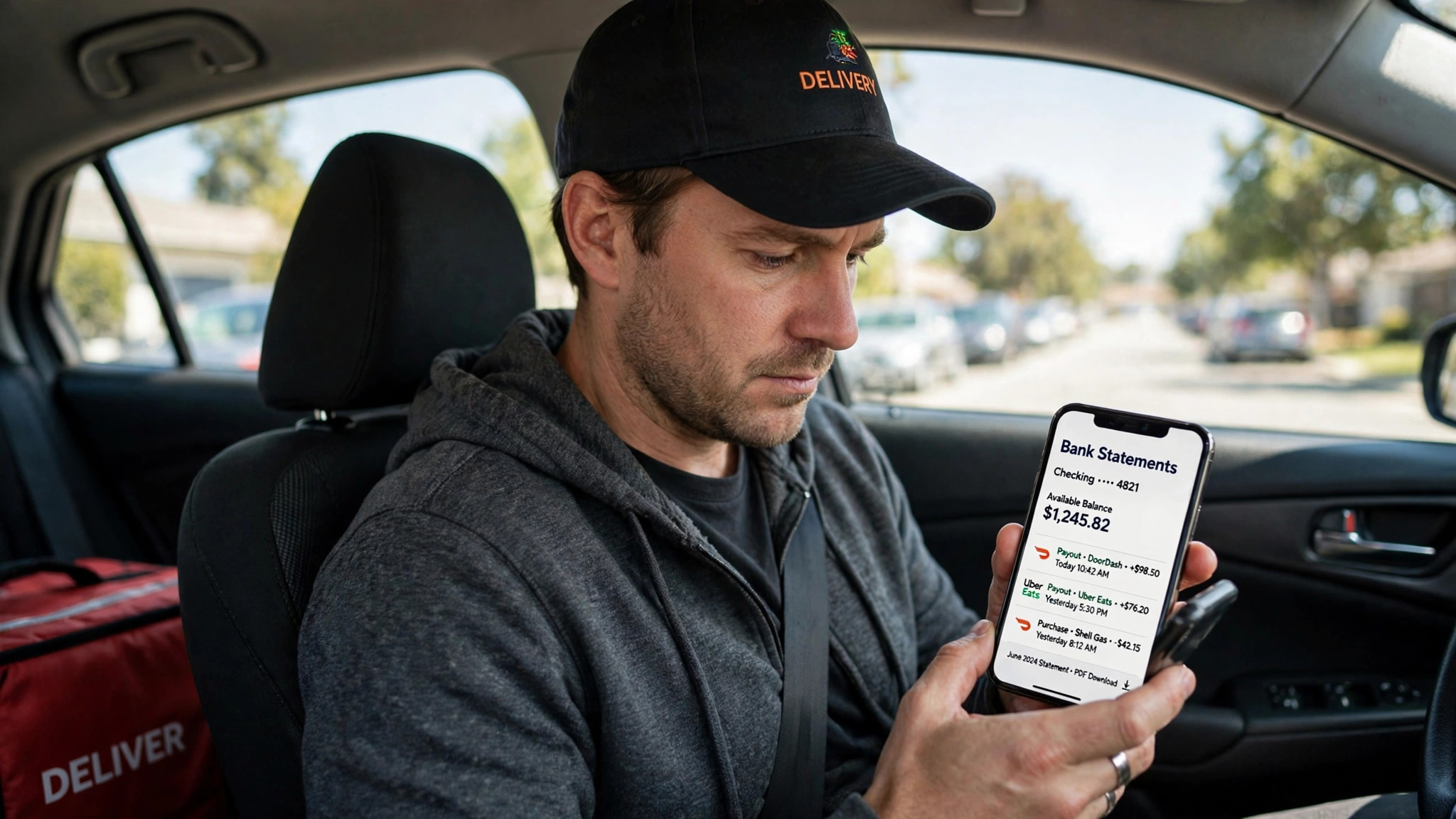
If you drive for Uber, deliver for DoorDash, or freelance, you know the frustration: traditional lenders ask for pay stubs, and you do not have any. Your income arrives as weekly payouts and direct deposits — and that is exactly what bank statements show. A statement tells a lender how much money comes in, how regularly it arrives, and whether your balance stays positive after bills. For a $5,000 loan, that is often enough, provided the rest of your application holds up.
Why Lenders Ask for Tax Returns — and Why Statements Can Replace Them
Every lender answers one question before lending: can this person reliably repay? For an employee, a pay stub answers it in one line. For a gig worker, the answer is scattered across app payouts and bank deposits, and the tax return is the document lenders trust most because it is a legal filing. Gig workers are self-employed for tax purposes, so income is reported on Schedule C — which is why banks often ask for one or two years of returns. But a driver who deducts mileage and phone costs aggressively may show little taxable income on paper while $3,000 a month flows through the checking account. A lender that only reads the tax return sees a borrower who looks poor; one that reads bank statements sees the real cash flow.
What Is a Bank-Statement Loan?
A bank-statement loan is not a special product with its own brand name. It is an ordinary unsecured personal loan where the lender accepts bank statements as the main proof of income instead of pay stubs or tax returns. You borrow a lump sum and repay it in fixed monthly installments, with the rate set by your credit score and income.
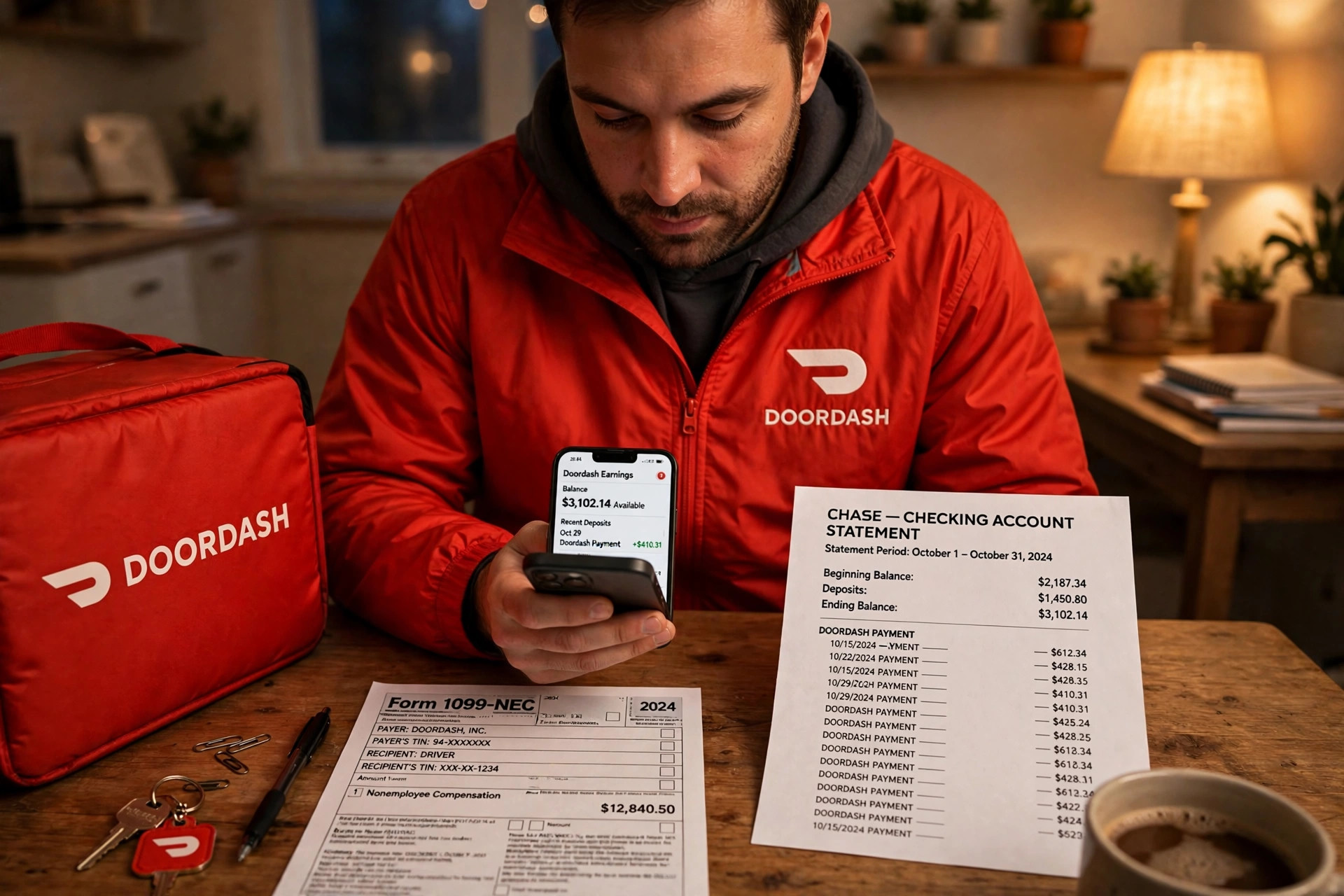
For a $5,000 loan, most lenders ask for two to three months of statements from your primary checking account. For larger loans, some ask for up to 12 months. First-year gig workers without a full tax return can often qualify with three to six months of statements plus their 1099 forms — the 1099-NEC or 1099-K that platforms send when earnings pass the reporting threshold. Statements plus 1099s give the lender two independent views of the same income, which is what an underwriter wants.
What Lenders Look for in Your Statements
Regular deposits. Weekly deposits from Uber, DoorDash, Lyft, Instacart, or Upwork show your income is ongoing, not a one-time windfall. If deposits are irregular, a six-month history helps show the pattern.
A consistently positive balance. Occasional dips are normal; a balance that regularly hits zero or goes negative is a red flag.
No unexplained large deposits. A sudden $2,000 deposit from an unknown source raises questions, so be ready to explain refunds, gifts, or transfers from savings.
Low return-payment activity. Bounced payments and non-sufficient-funds fees suggest your cash flow is tighter than your deposits imply. If recent statements show these, wait a month or two and clean up the pattern before applying.
Deposit volume in the right range. A gig worker depositing $2,000 to $4,000 a month with a consistently positive balance is a strong candidate for up to $5,000. Below $2,000 a month, a $5,000 loan is a bigger stretch, and the lender may offer a smaller amount or a higher rate.
Which Lenders Accept Bank Statements?
| Lender type | Typical loan amount | What they usually ask for | Source |
|---|---|---|---|
| Online lenders (Upstart, LendingClub, Avant) | $1,000–$50,000 | 2–3 months of bank statements; self-employment income accepted | Lender underwriting guidelines, November 2026 |
| Credit unions | $1,000–$50,000 | 2–3 months of statements plus Schedule C | Credit union lending practices, November 2026 |
| SBA microloan intermediaries | Up to $50,000 | Bank statements plus Schedule C | SBA microloan program guidance, November 2026 |
| CDFIs | Varies by program | Bank statements, 1099s, business records | U.S. Treasury CDFI Fund program descriptions, November 2026 |
Online lenders are usually the fastest route. Upstart, LendingClub, and Avant all accept self-employment income and use bank deposit history in underwriting, with amounts typically from $1,000 to $50,000. Decisions often come within a day. The trade-off is that rates for weaker credit can be high.
Credit unions are the option most gig workers overlook. One will usually ask for two to three months of statements plus your Schedule C, but rates are often lower, and a loan officer can look at your whole situation rather than a score alone.
SBA microloan intermediaries and CDFIs serve borrowers that traditional banks turn away, including self-employed workers with thin credit files. SBA microloan intermediaries accept bank statements plus Schedule C, and CDFIs — certified through the U.S. Treasury CDFI Fund — often combine lending with free business coaching. These are slower, sometimes taking weeks, but can be the best option if your credit is weak or your income history is short. Many lenders let you check your rate with a soft credit pull that does not affect your score, so compare two or three before committing.
What Will a $5,000 Loan Cost?
For a gig worker borrowing $3,000 to $5,000 with consistent deposits and no derogatory credit history, a realistic APR target is roughly 10% to 36%. Where you land depends mostly on your credit score and existing debts: high 600s or above with modest debts lands near the lower end, while low 600s or a recent late payment lands near the upper end. Offers above 36% are a sign to walk away and try a credit union or CDFI instead. For a $5,000 loan, a 24-month term is a common middle ground.
Worked Example: A $5,000 Loan at 24% APR Over 24 Months
Suppose Maya drives for Uber and delivers for DoorDash, with average monthly deposits of $3,200, a positive balance, and no late payments. She borrows $5,000 at 24% APR — an illustrative rate in the middle of the realistic range — over 24 months.
Her monthly payment is about $264. The math: at 24% APR the monthly rate is 2%, so the payment is $5,000 × 0.02 ÷ (1 − 1.02⁻²⁴), roughly $264.36 a month. Over 24 months she pays about $6,345 in total, of which about $1,345 is interest. If Maya qualified at 12% APR instead, her payment would drop to about $235 a month and her total interest to roughly $647 — a saving of about $700.
Before you borrow, run your own numbers. The gig true pay calculator shows what you actually earn after gas, taxes, and expenses, so you can check whether a $264 payment fits your real take-home pay — not your gross deposits. The full tools hub has the rest of the calculators. If your problem is proving income in general rather than borrowing a specific amount, our guide to getting a personal loan as a DoorDash driver with no pay stub covers every document and lender type.
How to Apply
1. Gather three months of statements. Download PDF statements for the checking account where your gig payouts land. 2. Collect your 1099s. Have any 1099-NEC or 1099-K forms ready; first-year workers should also gather payout summaries from the app. 3. Check your credit report. Pull your free reports and fix errors before applying — one wrongly reported late payment can cost several APR points. 4. Estimate your real monthly income. Add up deposits over three months, divide by three, then subtract gas, insurance, and phone costs. Only borrow a payment that fits that number. 5. Pre-qualify at two or three lenders. Use soft-pull rate checks and compare APR, monthly payment, origination fee, and term side by side. 6. Borrow only what you need. If you need $5,000, borrow $5,000.
What to Avoid
Merchant cash advances. These are priced as factor rates — typically 1.15 to 1.40 of the amount borrowed — rather than APR. A $5,000 advance at a 1.30 factor rate means repaying $6,500, often through daily automatic deductions that can strangle your cash flow. Avoid them. Payday-style products. Loans with repayment windows measured in days are designed to trap borrowers in a cycle of re-borrowing. Walk away. Lenders that promise approval. No legitimate lender guarantees approval before reviewing your application. Paying upfront fees. A legitimate lender deducts any origination fee from the loan proceeds. If someone asks you to pay a fee before you receive money, that is a scam.
FAQ
Can I get a $5,000 loan as a gig worker with no tax return at all? Often yes, especially with three to six months of statements showing regular deposits plus 1099 forms from your platforms.
How many months of bank statements do lenders want? Two to three months is typical for a $5,000 loan. Larger loans may require up to 12 months.
What credit score do I need? There is no single cutoff, but borrowers with no derogatory history and consistent deposits generally see APRs in the 10% to 36% range.
Does being a gig worker hurt my chances? It makes the application more paperwork-heavy, because you must prove income without pay stubs. It does not make approval impossible — lenders care about deposit history, credit history, and existing debts.
Is a bank-statement loan the same as a stated-income loan? No. A stated-income loan relies on the borrower's word. A bank-statement loan verifies income from actual deposit records, which lenders treat as real evidence.
Should I use income before or after expenses? Lenders look at gross deposits first, but budget on net income — deposits minus gas, insurance, maintenance, and taxes.
The Bottom Line
A $5,000 loan with bank statements and no tax return is realistic for a gig worker with steady deposits, a positive balance, and a clean credit history. Gather three months of statements, add your 1099s, check your rate at more than one lender — including a credit union — and borrow only what you need.
If you also drive for Uber and want rewards on the gas and expenses that come with the job, see our guide to the best business credit card for Uber drivers with no LLC.
This article is general information only and is not financial advice. Loan terms, rates, and lender requirements change over time and vary by state and by borrower. Check current terms directly with any lender before applying.
Last verified: November 2026