An Uber driver's true cost is typically $0.45 to $0.65 per mile, including gas, depreciation, maintenance, insurance, and self-employment tax. If Uber pays you $1.00 a mile, you keep roughly $0.35 to $0.55 a mile before income tax — and the exact figure depends on your car, your city, and how many miles you drive empty.
That per-mile number is the most important figure in rideshare driving. Uber pays per trip, not per mile, so a $12 trip that covers 15 miles is very different from a $12 trip that covers 5 miles. The first one may barely cover its costs. The second one is profitable. Drivers who know their cost per mile can accept the second kind of trip and decline the first — and that one habit does more for earnings than any driving trick.
This guide breaks down each cost, gives you a simple formula, and works through a real monthly example. All estimates are labelled as illustrative.
Why cost per mile matters more than pay per hour
Hourly pay feels natural, because most jobs pay by the hour. Rideshare does not work that way. Your costs are mostly per mile: fuel burns per mile, tires wear per mile, and your car loses value per mile. Your pay, meanwhile, is per trip, and trips vary wildly in length.
Two drivers can both earn $20 an hour and keep very different amounts. The driver who covers 15 miles an hour spends roughly $7 to $10 an hour on vehicle costs. The driver who covers 30 miles an hour spends roughly $14 to $20 an hour — and may keep almost nothing. Hours alone hide that difference. Miles per dollar earned reveal it.
That is also why dead miles matter. A mile driven to pick up a passenger, or driven empty back toward a busy area, costs the same as a mile with a passenger in the car, but earns nothing. A driver with many dead miles needs a higher fare per paid mile just to break even. Keeping dead miles low — by waiting in busy areas, and by declining pickups that are far away — is one of the cheapest ways to raise your real pay.
The cost-per-mile breakdown
| Cost | Typical range per mile | Notes |
|---|---|---|
| Gas | $0.12–$0.18 | Depends on fuel price and fuel economy |
| Depreciation | $0.15–$0.25 | Loss of vehicle value from mileage |
| Maintenance and repairs | $0.08–$0.12 | Oil, tires, brakes, and repairs |
| Insurance endorsement | $0.03–$0.05 | About $25–$50 a month for rideshare cover |
| Self-employment tax | $0.07–$0.10 | 15.3% on 92.35% of net profit, spread per mile |
| Total true cost | $0.45–$0.65 | Illustrative range for most drivers |
Sources: cost-per-mile ranges supplied for this guide, November 2026; fuel prices, insurance, and repair costs vary by car, city, and insurer. The table is a starting point, not a quote. Your own costs may sit at the low end if you drive a cheap, fuel-efficient car, or at the high end if you drive a larger, thirstier one.
Gas is the cost you see every week, so it feels like the biggest one. It is not. Depreciation is usually larger, but invisible until you sell the car. A car losing $0.20 a mile costs $200 per 1,000 miles, whether or not you notice it that week. Ignoring depreciation is the most common reason drivers overestimate earnings.
Insurance is the cost drivers most often get wrong. A personal policy usually does not cover you while driving for Uber. You typically need a rideshare endorsement, about $25 to $50 a month in the illustrative figures used here. Driving without proper cover risks a denied claim, which can cost far more than the endorsement. Check your policy and your state's rules before you drive.
The simple formula
Cost per mile is total monthly driving costs divided by total monthly miles. That is it. Add up everything the car costs you in a month — fuel, insurance, loan interest if you count it, maintenance, repairs, and an allowance for depreciation — then divide by the miles you drove for Uber that month, including dead miles.
Cost per mile = total monthly vehicle costs ÷ total monthly Uber miles
Use the same period for costs and miles. A weekly figure spots a bad week; a monthly figure is more stable, because repairs and insurance do not fall evenly week by week.
For tax purposes, most drivers use the IRS standard mileage rate instead of adding up actual costs. The rate for 2026 is $0.725 a mile from January 1 to June 30, 2026, and $0.76 a mile from July 1 to December 31, 2026. Never use $0.725 for all of 2026 — the rate changes mid-year. The mileage deduction replaces gas, insurance, repairs, and depreciation for tax purposes, so do not double-count those costs as well. Parking and tolls are deductible on top. Our guide to DoorDash driver tax deductions explains the same rules, which apply to Uber drivers too, in detail.
Worked example: $1,300 a month, 3,500 miles
Take an illustrative Uber driver with $1,300 a month in total vehicle costs and 3,500 miles driven for Uber that month. Dividing $1,300 by 3,500 gives about $0.37 a mile. That is below the typical $0.45 to $0.65 range, which suggests a cheap-to-run car, low repair costs, or a low allowance for depreciation. Treat it as a best-case example, not a typical one.
Now change one number: the same driver, but with $1,925 in monthly costs — the middle of the range at $0.55 a mile for 3,500 miles. If Uber pays $2,800 that month, the driver keeps $875 before income tax, or about $0.25 a mile. If Uber pays $2,100, the driver keeps $175, or $0.05 a mile. The same miles, the same car, and a $700 difference in fares is the difference between a decent month and a wasted one.
A second worked example shows the effect of dead miles. Suppose a driver earns $1,200 in a week and drives 800 miles, of which 200 are dead miles. Paid miles are 600, so the fare is $2.00 per paid mile — which sounds excellent. But costs apply to all 800 miles: at $0.55 a mile, that is $440, leaving $760 before tax, or $0.95 per mile driven. Cut dead miles to 100, and costs fall to $385, leaving $815. The driver earned the same fares and kept $55 more, simply by driving fewer empty miles.
To run your own numbers, use the gig true pay calculator. Enter your fares, miles, fuel price, and other costs, and it shows what is left after expenses and tax. You can also browse the full set of finance tools on Orafyn.
How to lower your cost per mile
You cannot change fuel prices, but you can change almost everything else. The biggest lever is the car itself. A fuel-efficient car that costs $0.12 a mile in gas beats a thirsty one at $0.18 a mile by $0.06 on every mile — $210 a month for a 3,500-mile driver. A car that depreciates slowly is worth even more. Buying a reliable used car for rideshare, rather than a new one, usually lowers depreciation sharply.
The second lever is maintenance. Regular oil changes, correct tyre pressure, and prompt attention to small problems cost less than the breakdowns they prevent. A $100 repair caught early is cheaper than a $1,000 repair caught late, and a car off the road earns nothing.
The third lever is insurance. Shop around for a rideshare endorsement, and check whether your insurer offers a discount for low mileage or a clean record. Do not drop the endorsement to save money — the risk of a denied claim is far larger than the premium.
The fourth lever is fuel. A card that pays 5% back on gas returns about $0.17 on a $3.50 gallon, which is roughly $0.007 a mile for a 25-mile-per-gallon car — small, but it adds up over thousands of miles. Our best gas credit card for delivery drivers guide compares the best options, including 5% gas cards. Delivery drivers face the same fuel math, and our how much a DoorDash driver really makes after gas and taxes guide uses the same cost-per-mile method for food delivery.
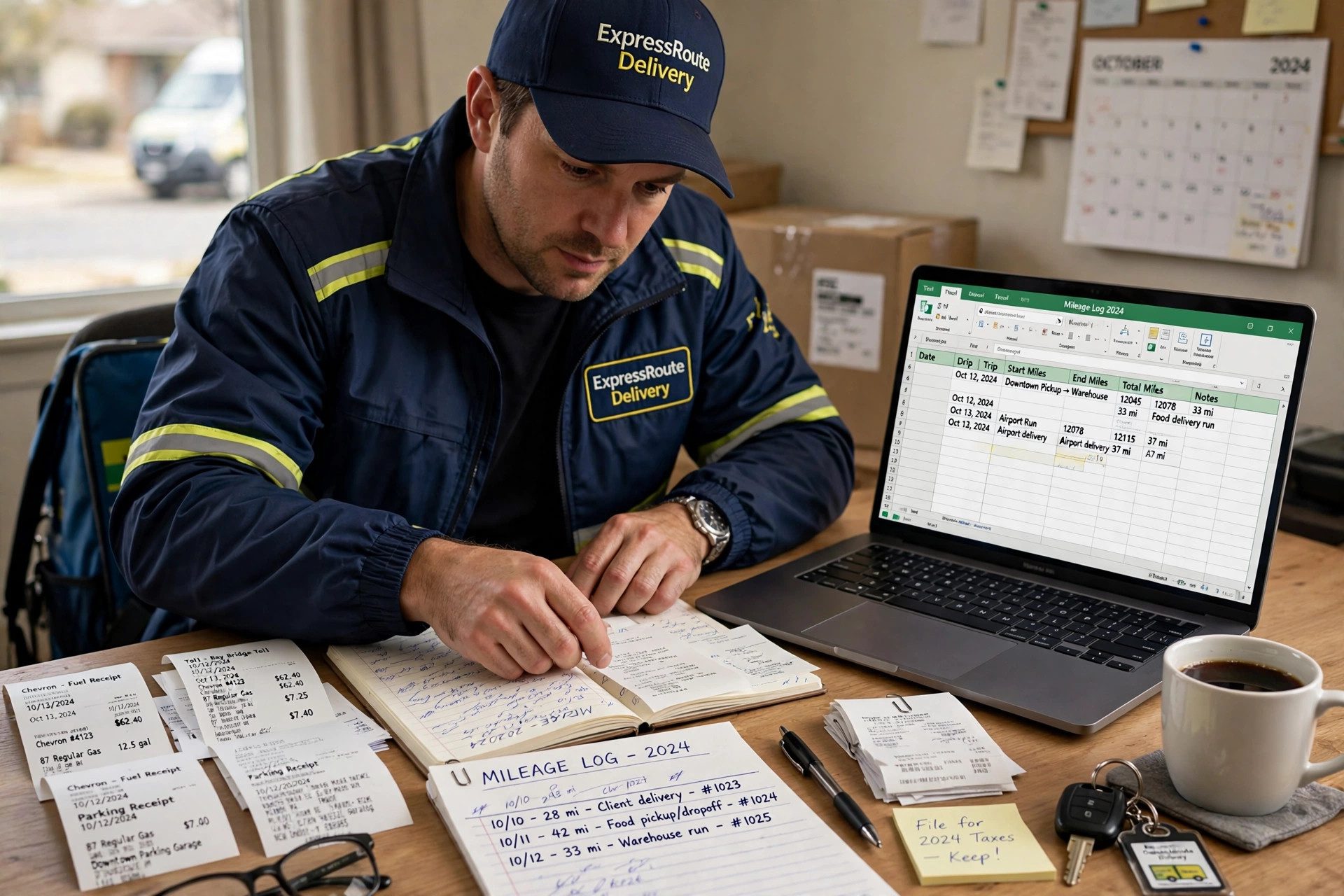
Finally, drive fewer dead miles. Wait where demand is, rather than cruising empty streets. Decline pickups that are far away unless the fare justifies the empty drive. And track your miles: a simple log, or a mileage app, gives you the denominator for every calculation in this guide.
FAQ
What is a good cost per mile for an Uber driver? Below $0.50 a mile is good; $0.45 to $0.65 is typical. Above $0.65 usually means a thirsty car, high depreciation, or high repair costs. Check the car first, then your dead miles.
How do I calculate my Uber cost per mile? Add up all monthly vehicle costs — fuel, insurance, maintenance, repairs, and depreciation — then divide by all miles driven for Uber that month, including dead miles. Or use the gig true pay calculator.
Does Uber pay for gas and insurance? No. Uber drivers are independent contractors. Uber pays fares, tips, and promotions; you pay fuel, insurance, maintenance, and tax. That is why the per-mile cost matters so much.
What is the IRS mileage rate for Uber drivers? For 2026, $0.725 a mile from January 1 to June 30, and $0.76 a mile from July 1 to December 31. The mileage deduction replaces gas, insurance, repairs, and depreciation for tax purposes — do not double-count.
Do dead miles count for the mileage deduction? Yes, if they are business miles. Driving to pick up a passenger, and driving between trips while available on the app, are generally business miles. Personal errands and miles with the app off are not. Keep a log.
How much should an Uber driver save for taxes? Many drivers set aside 20 to 30 percent of net profit, but the right amount depends on your total income, deductions, and tax bracket. Self-employment tax alone is 15.3% on 92.35% of net profit, before income tax. A tax professional can give you a figure for your situation.
Disclaimer: This article is general information only and is not financial advice or tax advice. Insurance rules, tax rates, and IRS rules vary by state and change over time. Check your own policy and consult a qualified tax professional before making insurance or tax decisions.
Last verified: November 2026