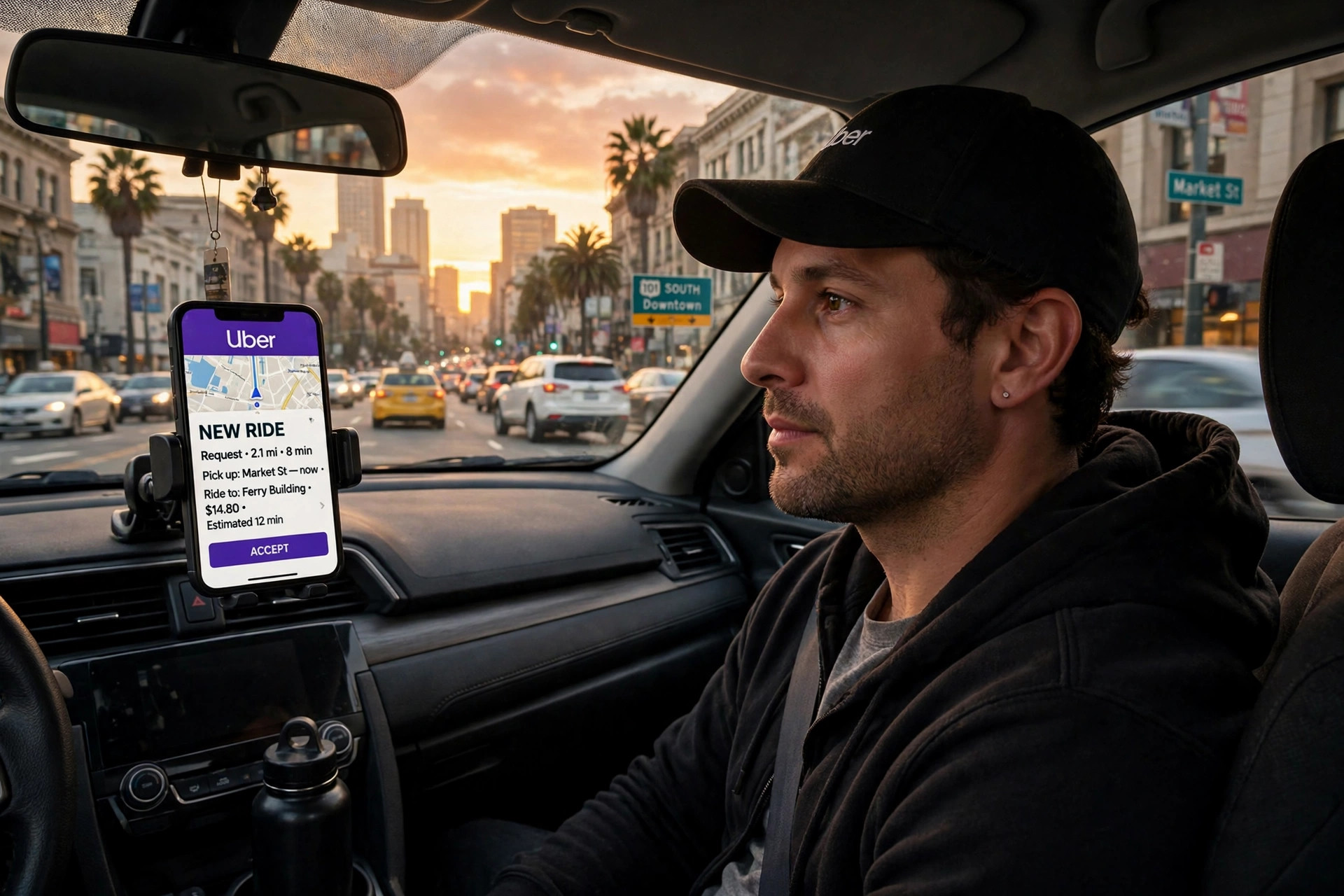
Rideshare insurance in Texas costs about $179 a month on average, versus $162 nationally. A rideshare endorsement on a personal policy typically adds $10 to $35 a month, commonly $15 to $30. Texas does not require the endorsement, but without one your personal policy excludes all driving while the Uber app is on.
That last point is the one that costs Texas drivers money. Texas law sets minimum coverage for rideshare companies, and Uber provides it — but only in slices, and only for liability. Your own car is the weak spot. If you crash while the app is on and you have no endorsement, your personal insurer can refuse the claim entirely, and Uber's coverage will not pay to fix your car unless you are on an active trip. The endorsement, which costs about the same as a tank of gas, closes that gap.
Texas Minimums: What the Law Requires
Texas requires all drivers to carry minimum liability coverage of 30/60/25: $30,000 for bodily injury per person, $60,000 per accident, and $25,000 for property damage. That is the floor for personal driving. Rideshare driving has a second layer on top of it, set by the Texas Transportation Network Company law in Texas Insurance Code Chapter 1954.
Under that law, the rideshare company must provide coverage that depends on which period you are in:
| Period | What is happening | Minimum coverage (Texas) |
|---|---|---|
| Period 1 | App on, waiting for a request | $50,000 per person / $100,000 per accident bodily injury; $25,000 property damage |
| Period 2 | En route to pick up a passenger | Up to $1,000,000 third-party liability; contingent collision and comprehensive with a $2,500 deductible |
| Period 3 | Passenger in the car | Up to $1,000,000 third-party liability; contingent collision and comprehensive with a $2,500 deductible |
Source: Texas Insurance Code Chapter 1954, November 2026.
Periods 2 and 3 look generous, and they are — $1,000,000 in third-party liability is serious protection. But two details matter. First, the collision and comprehensive coverage in Periods 2 and 3 is contingent, meaning it only applies if you already carry collision and comprehensive on your personal policy. Second, it carries a $2,500 deductible. A $2,000 repair bill on your own car during an active trip is entirely yours.
Period 1 is the thinnest coverage of all. The TNC minimums — $50,000 per person, $100,000 per accident, $25,000 property damage — cover injuries and damage you cause to others while waiting. They do not cover your own car at all. And in Period 1, your personal policy is the policy that would normally cover your car — except that it excludes app-on driving. That is the gap an endorsement fills.
What Rideshare Insurance Costs in Texas
| Coverage | Average monthly cost | Source |
|---|---|---|
| Rideshare insurance, Texas average | About $179/month | Insurify, November 2026 |
| Rideshare insurance, national average | About $162/month | Insurify, November 2026 |
| Liability-only, Texas | About $124/month | Insurify, November 2026 |
| Full coverage, Texas | About $233/month | Insurify, November 2026 |
| Rideshare endorsement add-on | $10–$35/month (commonly $15–$30) | Texas insurer rate filings, November 2026 |
Texas runs about $17 a month above the national average for rideshare insurance, reflecting the state's size, traffic, and storm and hail exposure. Full coverage in Texas averages about $233 a month, while liability-only averages about $124. The endorsement itself is the cheap part: $10 to $35 a month, commonly $15 to $30, added to whatever personal policy you already have.
A few insurer-specific figures are worth knowing, with their limits stated plainly. State Farm is among the cheapest rideshare insurers in Texas. Mercury offers rideshare coverage at about $0.90 a day — roughly $27 a month — but only in nine states, Texas included, so confirm availability in your ZIP code. USAA offers a rideshare add-on from about $6 a month, but USAA is military-only and most drivers cannot buy it. Allstate's rideshare add-on runs about $38 a month and covers the deductible gap — the difference between your personal deductible and Uber's $2,500 deductible on contingent collision claims.
Worked Example: A Houston Driver's Monthly Cost
Suppose Daniel drives for Uber in Houston. He carries full coverage, which in Texas averages about $233 a month. He adds a rideshare endorsement at $25 a month, in the middle of the typical $15 to $30 range. His total is $258 a month, or $3,096 a year, and he is covered in every period: waiting, en route, and with a passenger.
Now consider the deductible gap. Suppose Daniel has a $500 collision deductible on his personal policy. On an active trip, Uber's contingent collision coverage carries a $2,500 deductible — so a $2,000 repair to his own car would not be covered by Uber at all, and his personal policy excludes app-on driving. With an Allstate-style endorsement that covers the deductible gap, his out-of-pocket cost on that claim could fall back toward his own $500 deductible instead of the full $2,500. That is the practical value of the endorsement: not the headline liability limit, but the repair bill on your own car.
For a driver on a tighter budget, the liability-only route is about $124 a month plus a $25 endorsement, or $149 a month. That covers injuries and damage to others, but not your own car. Before choosing, work out what driving really costs you with the gig true pay calculator, and see your cost per mile with the Uber driver cost per mile calculator. The full tools hub has the rest of our gig calculators.
Do You Legally Need an Endorsement in Texas?
No. Texas does not require rideshare drivers to buy an endorsement. The legal requirement falls on the rideshare company, which must provide the Period 1, 2, and 3 minimums. But "not legally required" and "not needed" are different things. Without an endorsement, your personal policy excludes app-on driving, which creates three real problems.
First, your own car is unprotected in Period 1. The TNC minimums cover other people, not your vehicle. Second, your personal collision and comprehensive coverage — the coverage that makes Uber's contingent Period 2 and 3 protection work — can be voided for app-on driving if your insurer learns the car was used for rideshare. Third, some insurers cancel policies when they discover undisclosed rideshare use.
How to Buy Rideshare Insurance in Texas
1. Ask your current insurer first. Many large Texas insurers offer a rideshare endorsement. If yours does not, shop elsewhere. 2. Compare at least three quotes. Texas rates vary widely by city — Houston, Dallas, and Austin price very differently — and by driving record. 3. Ask about the deductible gap. Specifically ask whether the endorsement covers the difference between your personal deductible and Uber's $2,500 deductible. 4. Confirm Period 1 coverage in writing. The endorsement should state that it covers you while the app is on and you are waiting for a request. 5. Disclose your rideshare use. Hiding it risks a denied claim or a cancelled policy. Disclosing it is what the endorsement is for.
Drivers who also deliver food should note that delivery has different rules: DoorDash's coverage and Florida's insurance framework work differently from Texas rideshare law. Our guide to DoorDash delivery insurance in Florida explains the delivery side, including the waiting-period gap that DoorDash's own policy leaves open. California drivers face yet another set of rules — see our guide to rideshare insurance in California.
What to Avoid
Driving app-on with no endorsement. Texas does not require it, but your personal policy excludes app-on driving. The gap is real, and Period 1 is where it bites.
Assuming Uber's $1,000,000 covers your car. It covers third-party liability in Periods 2 and 3. Your own car is covered only by contingent collision with a $2,500 deductible — and only if you carry collision on your personal policy.
Choosing an insurer that does not sell rideshare coverage in Texas. Mercury's $0.90-a-day rate applies in nine states including Texas, but availability varies by ZIP code. USAA's $6-a-month add-on is military-only. Confirm availability before comparing prices.
Letting the endorsement lapse. If you switch insurers or change vehicles, confirm the endorsement carries over. A policy without it is a personal policy again, with the same gap.
FAQ
How much does rideshare insurance cost in Texas? About $179 a month on average, versus $162 nationally. Liability-only averages about $124 a month and full coverage about $233 a month in Texas (Insurify, November 2026). An endorsement alone typically adds $10 to $35 a month.
Does Texas require a rideshare endorsement? No. Texas does not require drivers to buy an endorsement. The coverage requirement falls on the rideshare company under Texas Insurance Code Chapter 1954. But without an endorsement, your personal policy excludes app-on driving.
What does Uber cover in Period 1 in Texas? In Period 1 — app on, waiting for a request — the TNC minimums are $50,000 per person and $100,000 per accident for bodily injury, plus $25,000 for property damage. That covers other people, not your own car.
What is Uber's deductible on collision claims? Uber's contingent collision and comprehensive coverage in Periods 2 and 3 carries a $2,500 deductible. Some endorsements, such as Allstate's, cover the gap between your personal deductible and that $2,500.
Is State Farm the cheapest rideshare insurance in Texas? State Farm is among the cheapest in Texas, but the cheapest insurer varies by driver, city, and record. Get at least three quotes before deciding.
Does my personal policy cover me while driving for Uber? No, not while the app is on. Personal auto policies exclude rideshare and commercial use. That exclusion is exactly what a rideshare endorsement removes.
The Bottom Line
Texas rideshare insurance averages about $179 a month, but the number that matters most is the endorsement: $15 to $30 a month to close the gap your personal policy leaves while the app is on. Texas does not require it, yet driving without it leaves your own car unprotected in Period 1 and risks a denied claim in every period. Ask your insurer for the endorsement by name, confirm it covers Period 1 waiting time and the deductible gap, and get three quotes before you renew.
This article is general information only and is not financial advice. Insurance rates, coverage terms, and Texas requirements change over time and vary by insurer, city, and driver. Check current terms directly with any insurer before buying.
Last verified: November 2026